 Important Notice— Our url is



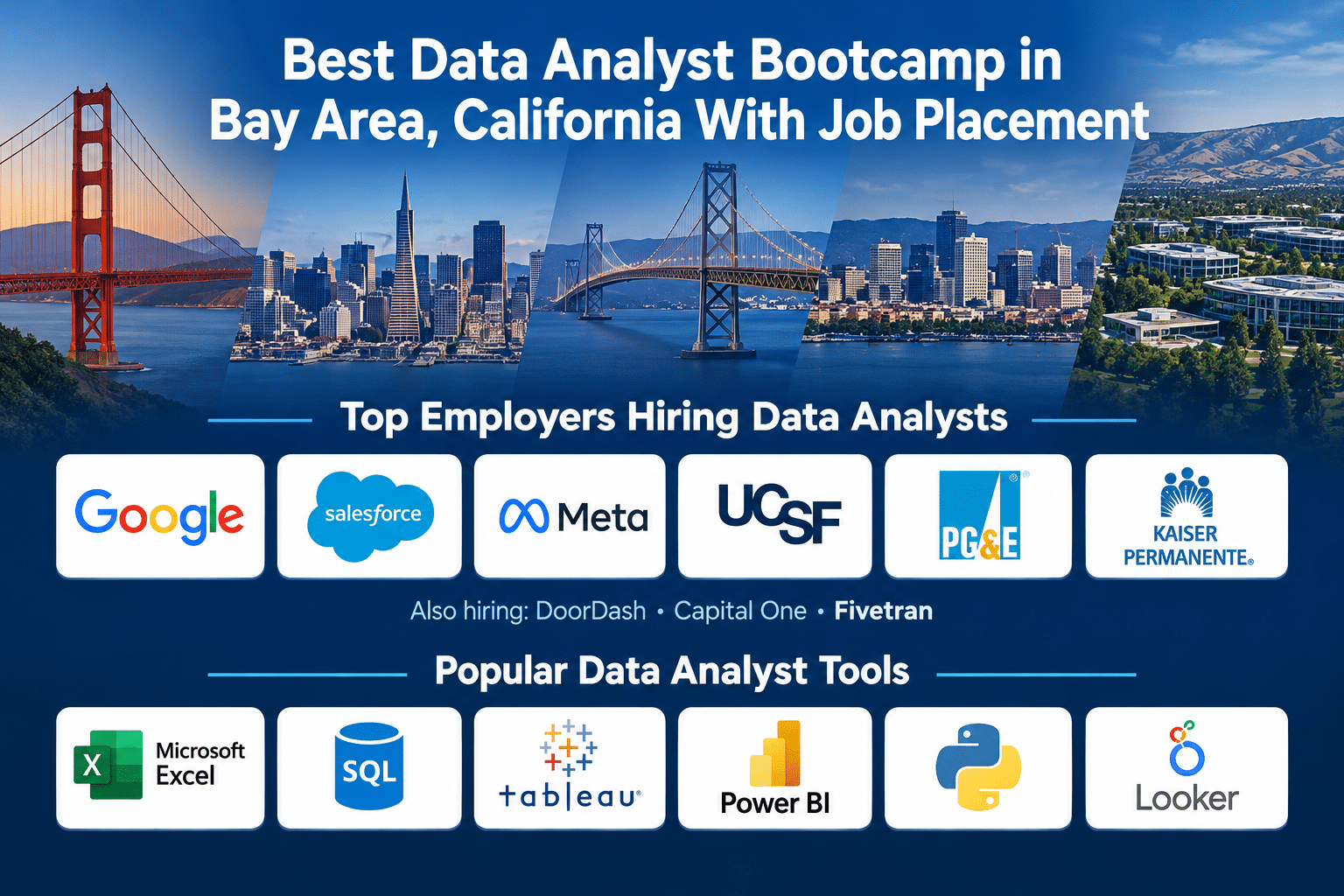
Best Data Analyst Bootcamp in Bay Area, California With Job Placement
The Best Data Analyst Bootcamp with Job Placement in Bay Area, California is not the shortest certificate. It is the path that still gets someone hired after AI has flattened basic spreadsheet, QA, and reporting work. SynergisticIT treats that path as a placement program, not a class that ends with a PDF.
Why analyst skill still matters
Data Analyst skills matter because Bay Area companies still run on decisions, not dashboards alone. A product team in San Francisco, a payments group in the South Bay, or a retail lab needs someone who can define the question, pull a clean dataset, and explain what should change next week. That work has not disappeared. The bar has moved.
Emerging skills employers now attach to analyst and Business Intelligence reqs include:
- SQL beyond filters: window functions, CTEs, and query tuning
- Python with pandas for cleaning and repeatable analysis
- Power BI, Tableau, or Looker, plus metric definitions stakeholders trust
- Cloud warehouses such as Snowflake or BigQuery, and pipeline habits with dbt and orchestration tools
- AI-assisted analysis: prompting a copilot, then checking every number
- Data governance, privacy, and the ability to say when a model output is not decision-ready
A San Francisco data analyst posting often sits near $125,308 a year on recent Indeed figures, with Salary.com putting the city average around $121,901 and a wide band from the high $90,000s into the $140,000s. Those numbers are for people who can do more than Excel.
Traditional Business Analyst, QA, and narrow Data Analyst seats are shrinking because AI drafts user stories, test cases, and first-pass charts, while finance teams cut roles that only reformat reports. Companies want hybrid candidates who can cover data analytics, data science, ML/AI, and data engineering, not only basic SQL, Excel, manual test scripts, or ticket triage.
Just Data Analyst skills are not enough. Hiring managers ask for stacks, not a single tool.
Data analytics and BI: Excel, SQL, Power BI, Tableau, Looker, statistics, stakeholder storytelling.
Data engineering: Python, SQL, Snowflake, Databricks, AWS or Azure, dbt, Airflow, warehouse modeling.
Data science, machine learning, and AI: Python, scikit-learn, PyTorch, feature work, evaluation, LLMs, and enough engineering sense to ship a model with the data team.
QA testers, Business Analysts, program managers, and people from statistics, mathematics, or non-coding backgrounds should start through SynergisticIT Data Science JOPP if the goal is a data career rather than another certificate. Overlap is real and mostly non-code at the start: requirements, process maps, acceptance criteria, Excel, light SQL, documentation, defect thinking, and explaining tradeoffs. Data validation is close to test design. A BA already translates business pain into questions. A program manager already sequences work. JOPP adds warehouses, Python, ML, and projects on top of those habits.
In the San Francisco Bay Area, data analysts and business intelligence analysts stay in demand because the region’s largest employers still run on metrics, not intuition. Product teams, finance groups, clinical operations, and advertising platforms need people who can turn warehouse data into trusted dashboards, cohort views, and executive narratives. AI has automated some reporting, but it has also increased the volume of data that must be governed, explained, and tied to revenue, risk, and customer outcomes. That keeps SQL, visualization, experimentation, and stakeholder translation skills valuable even when pure software hiring cools.
Employers that regularly hire for these roles, and that are not staffing firms, include Google, Meta, Apple, Salesforce, Oracle, Adobe, NVIDIA, Intel, Cisco, Intuit, LinkedIn, Netflix, Uber, Lyft, Airbnb, DoorDash, Stripe, Block, PayPal, Visa, Workday, ServiceNow, Databricks, OpenAI, and Genentech. These organizations span search, social, devices, enterprise software, semiconductors, payments, marketplaces, and life sciences, so analyst demand is not limited to one product cycle.
Typical Bay Area pay sits well above national medians, and total compensation at large tech employers can run higher once bonus and equity are included. For data analysts, a junior or entry band commonly falls around $74,000 to $98,000, with a San Francisco junior average near $86,000 in base and about $92,000 in total cash in one Built In sample. Mid-level analysts more often land around $95,000 to $140,000 in base, while broader data-analyst postings in the region have been reported from roughly $70,000 to $200,000 depending on company and scope. Senior data analysts commonly see bases around $110,000 to $190,000, with a local senior average near $139,000 and some specialized or principal roles reaching $210,000 or more before equity. For BI analysts in California, Salary.com data as of late 2026 put the typical range near $107,000 to $153,000, with averages around $128,000; experience bands run from roughly $76,000 at entry to about $127,000 mid-career and $141,000 at a senior level, with expert roles much higher. Levels.fyi’s Bay Area business-analyst median total compensation was about $155,000 in November 2026, with the 25th to 75th percentile near $113,000 to $204,000, and Meta reported around a $255,000 median total for that title. Offers at Google, Apple, NVIDIA, and Salesforce can sit at the top of these bands when stock is included.
The people most associated with this economy include Jensen Huang of NVIDIA, Marc Benioff of Salesforce, Sam Altman of OpenAI, Mark Zuckerberg of Meta, and Sundar Pichai of Google. Their companies, along with long-standing institutions tied to Larry Ellison and Oracle, still shape how the region hires technical talent.
The employment picture in late 2026 is mixed rather than booming in every function. Open tech roles have concentrated back in the Bay Area, with about 15 percent of open roles at tech companies based there and Bay Area openings up 43 percent from a year earlier, according to a late-2026 hiring review. At the same time, earlier 2026 layoffs and slower engineering growth mean competition is real, especially for juniors. Analyst hiring has held up better where companies need measurable decisions on AI products, ads, fintech risk, and healthcare operations, which is why Databricks, Stripe, Visa, Genentech, and the large platforms above continue to recruit.
Who JOPP is built for
SynergisticIT’s Job Placement Program is the hiring engine. SynergisticIT’s Data Science JOPP is the analytics, engineering, and AI track inside it. Both are live and remote, so a Bay Area candidate is not waiting on a campus seat.
Career gap or break
- Training is current, so a multi-year pause is not the story on the resume.
- Projects replace “I used to” with artifacts a recruiter can open.
- Interview practice covers the gap question without apology scripts.
- Client marketing does not leave a returning candidate to cold-apply alone.
- Screening happens before introductions, so the first employer conversation is about fit, not whether the person still works.
Recent graduates with no experience
- JOPP supplies tech skills a diploma rarely proves in an interview.
- Project work becomes the experience section.
- SynergisticIT states that 90% of JOPP graduates who get hired had never held a tech job; the other 10% are career changers and people with gaps.
- Certifications and a coached resume give a new grad something other than coursework.
- Placement support continues until a tech role starts, which is the missing piece after most graduations.
Jobseekers who want a tech hire, not a course completion
- Daily live instruction builds depth instead of a weekend overview.
- The stack matches roles employers are actually opening.
- Resume lines come only from projects completed in the program.
- Interviews are scheduled, not merely advised. Read ideal body language for interviews alongside technical prep, and use data analyst interview questions as a practice bank.
- The fee structure ties the balance to an offer, which bootcamps that collect everything on day one do not do.
Bay Area hiring context
Policy and infrastructure shape who gets hired here. Employer density is the first factor: Apple, Visa, PayPal, Cisco Systems, banks, and hundreds of smaller product teams sit inside one commute shed, so specialized reqs appear faster than in a single-industry city. Transit matters because a South Bay campus and a San Francisco office are not the same job. BART, Caltrain, VTA, and highway corridors decide whether a hybrid schedule is livable. Core cities have strong commercial broadband; outer counties still see uneven fiber, which affects remote-heavy teams. California’s research credit rewards in-state R&D—15% of qualified expenses above a base, or a 3% alternative simplified credit—so firms that keep engineers physically in California have a tax reason to hire here, not only a brand reason. Visa processing is part of the labor market, not a side note. The Bay Area has held about 80% of California H-1B recipients, and approved petitions in 2021–2024 were the second-highest of any U.S. metro, equal to over 1% of local jobs. Older census analysis put foreign-born workers at about 71% of Silicon Valley tech employment and about 50% in the San Francisco–Oakland–Hayward area. That is not a clean citizen-to-H-1B ratio—permanent residents, citizens, and other visas are mixed in—but it shows why employers here already interview immigrant and U.S. talent in the same pipeline.
A typical Bay Area loop starts with recruiter outreach or an application screen, then a call on comp and work authorization, then a skills test. Analyst loops lean on SQL, a metrics case, or a dashboard walkthrough more than pure algorithm puzzles. Engineering-adjacent data roles add a coding screen. On-site or virtual on-site rounds cover a hiring manager, a cross-functional partner, and sometimes a presentation. Offers at larger firms often land in three to eight weeks; slow loops lose candidates who are in three processes at once. Senior searches can run eight to twelve weeks.
Nightlife and social life for single jobseekers cluster where transit and late kitchens overlap: San Francisco’s Mission, Hayes Valley, and SOMA after-work scene; Oakland’s food and music corridors; downtown San Jose and Santana Row for South Bay weeknights; University Avenue in Palo Alto when the office is on the Peninsula. Meetups, hack nights, and run clubs double as networking. Housing cost is the tax on that social life.
Families usually choose schools and commute before nightlife. Peninsula districts such as Palo Alto Unified and South Bay high schools serving Cupertino and Sunnyvale are frequent relocation targets. Fremont offers BART, more space than the Peninsula, and a shorter hop to many East Bay and South Bay offices. The tradeoff is price, traffic, and school-lottery complexity inside San Francisco. People stay for career density, specialized teams, and schools. People leave for housing, a brutal commute, remote policies that no longer require the zip code, and competition from Seattle, Austin, and fully remote employers. The career ladder is still taller here for data, payments, and AI. The cost of standing on it is higher too.
Reasons to join our Best Data Analyst Bootcamp with Job Placement in Bay Area, California
How bootcamps compare
A guide to Data Analyst Bootcamps in Bay Area, California has to separate formats before it separates brands.
University and extension short courses run evenings, often recorded plus a weekly live lab, for working adults who want Excel, SQL, and a viz tool. Fees commonly land in the low thousands. Hiring support is usually advising, not interview scheduling.
Immersive career bootcamps, including programs historically sold in San Francisco such as General Assembly analytics and data tracks, have charged roughly $4,500 for a short analytics course and about $16,450 for a longer data science immersive of around 12 weeks. Instruction may be in person, live online, or hybrid. Cohorts mix career changers, recent grads, and career-break returners. Loans, installment plans, and sometimes income-share agreements appear in the fine print. Success rates are often self-reported. Alumni praise structure and community. Public forums criticize outdated projects, large class ratios, refund clauses that fail in practice, and job help that stops at resume tips.
Short skills studios in the city may offer 18 to 30 hours. They are useful for a tool, not a career change.
National online brands market to Bay Area applicants with recorded libraries, one or two generalist instructors, and upfront tuition from several thousand dollars to the mid-teens. Reviews split the same way: clear curriculum on the positive side; on the negative side, weak screening, embellished outcomes, and graduates who never reach a hiring manager.
Not all Data Analyst Bootcamps and coding bootcamps are equal. Closures at providers such as 2U’s university bootcamps, Southern New Hampshire University’s camp, Epicodus, and earlier schools such as Dev Bootcamp followed promises the market would not cash. Employers wanted deeper skills; AI cut demand for shallow entry coding; placement rates could not survive scrutiny. Learn a technology in depth from a firm that has been in the tech industry over 15 years—SynergisticIT, operating since 2010—not from a campaign that appeared with the last ad cycle.
How SynergisticIT differs from bootcamps, staffing shops, and certificate mills
Curriculum quality: Staff attend industry rooms such as Oracle CloudWorld and Gartner data and analytics events, and candidates are in live interviews, so the syllabus moves when reqs move.
Instructor quality: Industry practitioners, with an average instructor experience above 10 years, not alumni teaching a few hours from a recording.
Number of instructors: 5 to 6 specialists on the data side—separate voices for data analytics, data engineering, and data science / machine learning—and the same specialist model on Java, databases, advanced Java, and DevOps. Most camps use one or two generalists.
Cost and payment: $10,000 before the program. The balance, capped at $26,000, is due only after a job offer and is paid over two years. No offer, no balance. Many bootcamps take full fees first and advertise a refund that enrollees cannot redeem.
Duration: About 4 to 5 hours a day, five days a week, across about five months, live, with no recorded core. Ask any other camp that question and get the answer in writing.
Student-to-instructor ratio: About 5 to 1, against roughly 20 to 1 elsewhere.
Projects: Built to current client stacks. Only completed work hits the resume.
Alumni outcomes: Written, photo, audio, and video reviews describe offers from $95,000 to $155,000, including multiple offers. Read them on SynergisticIT reviews.
Certifications at no extra cost: Microsoft, Oracle, Snowflake, Databricks, Azure, and AWS.
Placement after class: Marketing to 24,000+ company contacts, resume work, interview prep, and scheduled interviews from enrollment through day one. A staffing firm may submit a resume. A bootcamp may email tips. Neither walks the full distance.
Why trust the claim: Alumni photos, offer letters, video reviews, and years in business are public. SynergisticIT does not sell a guarantee buried in hidden clauses. Cost and job outcomes are stated up front. Fancy ads are not the proof. Results are. The USA Today feature on how SynergisticIT sources tech talent is discussed across its hiring articles; the ROI case versus college is in the ROI blog.


Who can enroll in our Best Data Analyst Bootcamp with Job Placement in Bay Area, California?
Career opportunities after our Best Data Analyst Bootcamp with Job Placement in Bay Area, California

Why employers hire, and how to start
Companies hire SynergisticIT JOPP candidates because the program is shaped by client demand. Current tech stack alignment means less ramp-up. Pre-screened talent means a hiring manager meets people already checked for technical and job fit. Certifications in Java, DevOps, AWS, Azure, Power BI, Snowflake, and related tools add proof to a mixed stack. Multi-stack skill lets one junior contribute across analytics, engineering, and ML, or across backend, frontend, and deployment, instead of three narrow hires. Reduced hiring risk comes from structured training, projects, interview prep, and screening. Day-one contribution is the point of that sequence. Project-based resumes are built from work done, not inflated titles. In short, employers see candidates who are trained, screened, project-ready, interview-prepared, and aligned with open roles.
Visa, Apple, PayPal, Walmart Labs, AutoZone, Wells Fargo, Capital One, Walgreens, Bank of America, SAP, Cisco Systems, Verizon, T-Mobile, Intuit, Ford, Hitachi, Western Union, Deloitte, Dell, USAA, Carfax, Humana, and others have hired SynergisticIT candidates at $95,000 to $155,000. Partial fees come first. The balance starts only after a hire at $81,000 or higher. Against a six-figure degree that can take years before a paycheck, that structure is why JOPP is positioned as the higher-ROI route. Recent graduates should join for skills, projects, and the outcome that matters: a tech role at a real company. Bootcamps fail that test often enough that the sector keeps shrinking.
Waiting will not compress the calendar. It only pushes the offer further out. The months exist because skills, projects, interviews, and client marketing have to stack until someone says yes. That hard middle is what employers are paying for. Begin now. The road is long. The finish is a full-time offer.
Hundreds of programs will sell Data Analyst Bootcamp training in Bay Area, California. If the goal is a hire after the bootcamp, the choice this model is built around is SynergisticIT’s Best Data Analyst training Bootcamp in Bay Area, California—the Best Data Analyst Bootcamp in Bay Area, California with job placement, not a certificate and a goodbye.
Start the data analyst career here: review SynergisticIT’s Job Placement Program and call (510) 550-7200 to get on a live cohort.